
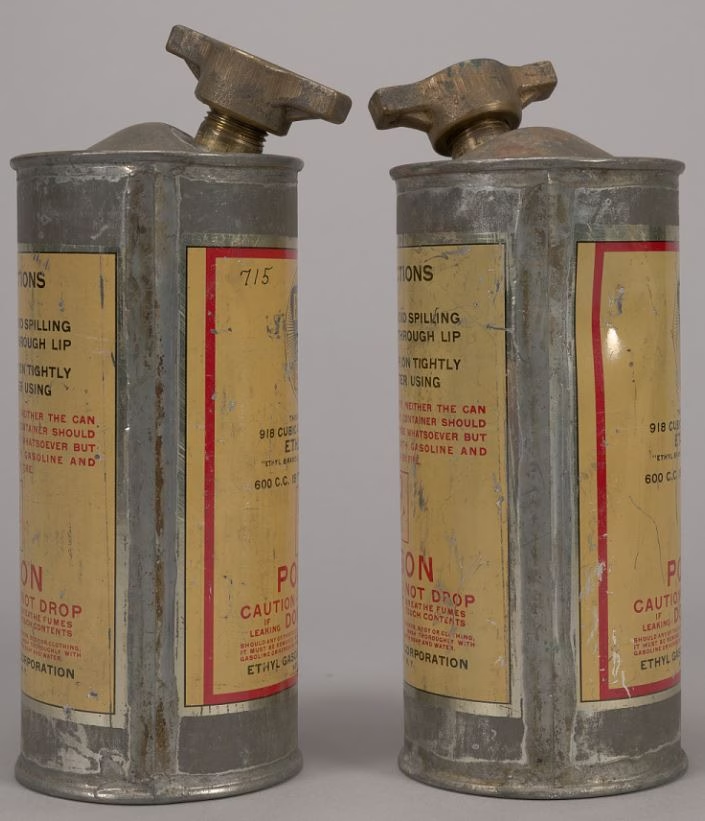


Description
- Weight of the creature: Up to 170 kg
- Quantity of substance: 1 can
- Form of substance: Pressurized gas
- Type of substance: Deadly poison
- Composition: Tetraethyl lead, butane, flower aromas
- Country of production: Vietnam
- Active substance: Tetraethyl lead
- Concentration: 70%
- Principle of action: Insomnia, visual disturbance, convulsions
- Death: Death occurs within the first 2-5 days
- Weight: 250 grams
ery dangerous poison in gaseous form is enough to spray the gas in a
room of 100 square meters all living things are killed. The action of
this poison is based on its vapors that get into the lungs of living
creatures. You can also spray in the car or direct the jet on the
furniture sofa table chairs etc. Tetraethyl lead is sold at us in spray
cans and in the composition added floral fragrance to not irritate the
smell of the poison itself! We also send you goggles, gloves, respirator
and instructions on how to spray the poison properly.
What is tetraethyl lead?
“a
colorless liquid with a sweet odor, very poisonous if absorbed through
the skin, resulting in lead poisoning almost immediately.”
…organometallic compound containing the toxic metal lead that for much
of the 20th century was the main antiknock agent in automotive gasoline,
or gasoline. Beginning in the 1970s, “leaded gasoline” was gradually
phased out, first in the United States and then in Europe and around the
world, due to its contribution to lead poisoning and its interference
with pollution control devices. installed in cars.
TEL can cause
acute or chronic lead poisoning if inhaled or absorbed through the skin.
In fact, the industrial chemist widely credited with discovering the
compound’s antiknock properties, Thomas Midgley Jr., was forced to leave
his job for several months in 1923 to recover from lead poisoning. From
1923 to 1925, several workers suffered agonizing deaths from acute lead
poisoning in the first factories built by the General Motors
Corporation, the DuPont Company, and the Standard Oil Company (New
Jersey) to produce TEL on an industrial scale. The dangers of lead
poisoning were well known at the time.
Inhalation
The
amount absorbed by the respiratory system depends on particle size,
respiratory volume, amount of deposition and mucociliary clearance of
inhaled lead.
Almost all inhaled lead is absorbed by the body
(with children generally absorbing a higher percentage than adults as
they have a higher respiratory rate)
Dermal
Organic lead may be absorbed directly through the skin.
Organic lead (tetraethyl lead) is more likely to be absorbed through the skin than inorganic lead.
What are the possible health effects of lead exposure?
The nervous system is the organ system most sensitive to lead.
Lead toxicity can affect all organ systems.
At the molecular level, proposed mechanisms of toxicity involve
fundamental biochemical processes. These include lead’s ability to
inhibit or mimic the actions of calcium (which may affect
calcium-dependent or calcium-related processes) and to interact with
proteins (including those with sulfhydryl, amine, phosphate, and
carboxyl groups)
Lead’s high affinity for sulfhydryl groups makes it particularly toxic to multiple enzyme systems, including heme biosynthesis.
The National Toxicology Program and the American Academy of Pediatrics
concluded that there is sufficient evidence of adverse health effects
in children and adults with blood lead levels (BLLs) <5 micrograms
per deciliter (µg/ dL ).
“There is no identified limit or safe level of lead in the blood”




Reviews
There are no reviews yet.