
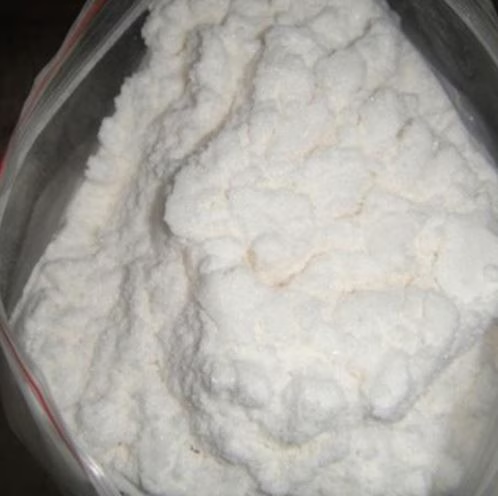


Description
What is HU-210 ?
HU-210 is a synthetic cannabinoid that was discover around 1988 in the group of Dr Raphael Mechoulam at the Hebrew University.
However HU-210
is 100 to 800 times more potent than natural THC from cannabis and has
an extended duration of action. HU-210 is the (+)-1,1-dimethylheptyl analog of 7-hydroxy-delta-6-tetrahydrocannabinol. The abbreviation HU stands for Hebrew University.
HU-210 Dosage
HU-210
with daily high doses over a few weeks stimulates neural growth in
rats’ hippocampus region, the opposite effect of drugs like alcohol,
nicotine, heroin, and cocaine.
It was also indicate by this increased neural growth to entail antianxiety and antidepressant effects.
HU-210,
along side WIN 55,212-2 and JWH-133, is implicated in preventing the
inflammation caused by Amyloid beta proteins involved in Alzheimer’s
Disease, in addition to preventing cognitive impairment and loss of
neuronal markers.
This anti-inflammatory
action is induce through the agonization of cannabinoid receptors which
prevents microglial activation that elicits the inflammation.
Additionally, cannabinoids completely abolish neurotoxicity related to microglia activation in rat models.
HU-210
is a potent analgesic with many of the same effects as natural THC.
This means that HU-210 could potentially be used in medicine as an
alternative to medical marijuana,
However
its much stronger and longer lasting effects compared to those of THC
could make appropriate titration of dosage difficult.
Also because HU-210 is a CB1 full agonist as opposed to THC which is a partial agonist,
The sedative effects of HU-210 are much more prominent, meaning that while fatal overdoses of THC.
Itself are virtually impossible, they would be possible with HU-210.
Effect of HU- 210
HU-210 block beta-amyloid peptide-induced activation of cultured microglial cells, as judged by mitochondrial activity.
The
cell morphology, and tumor necrosis factor-alpha release; these effects
are independent of the antioxidant action of cannabinoid compounds and
are also exert by a CB2-selective agonist.
HU-210 induced a
spatial deficit in the water a reference memory task in numerous
parameters together with alterations in hippocampal firing patterns.




Reviews
There are no reviews yet.