
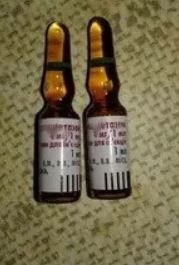


Description
The powerful poison Cicutoxin is
tasteless and odorless and is added to liquids up to 1 liter. After
taking a small volume of poisoned liquid within 3 hours, death occurs.
Also in the parcel we will send instructions on how to properly use this
poison in English.
What is Cicutoxin?
Also known as
“hemlock”. This very poisonous plant belongs to a small genus of four
dangerous plant species. Water hemlock is a perennial herbaceous plant,
which means it can live up to two years and has the ability to survive
the harshest winters, blooming again in the spring. These plants can
grow to a height of 2.5 meters (or 8.2 feet). They have green and white
flowers that hang like an umbrella, growing easily in temperate
climates. They are most commonly found in North America and Europe and
grow in damp fields, along riverbanks and other marshy locations. The
stem of this plant is forked, straight, flat and hollow with leaves
diverging from the fork. At the base of its stem there is a tuberous
root with thickened rootstocks, that is, they have thickened roots in
the underground part of the plant with rootstock.
“CICUTOXIN” OR POISON
So
what makes “cicuta” one of the most dangerous plants around? Well,
Water Hemlock rootstock is a multi-chambered root that contains a
yellow-colored oily substance that turns red when exposed to air. Fun
fact: it smells like carrots or parsnips. One property of the poisonous
substance, cicutoxin, is an allergic reaction. It has the ability to
aggravate the skin due to its mucous membranes and its antibacterial
activity. Cicutoxin has a chemical structure closely related to
enantotoxin, a poison that affects the central nervous system. This
could spell disaster for those who have an unknown allergy to this
plant. Cicutoxin is present in all growth stages and parts of hemlock;
it concentrates mainly on the roots and appears to be most toxic in
early spring. The effect of cicutoxin acts as a stimulant on the central
nervous system. It is a non-competitive (GABA), which stands for
“gamma-aminobutyric acid” and is the main inhibitory neurotransmitter of
the mammalian central nervous system. Its main function is to reduce
the excitability of neurons throughout the nervous system, therefore, if
ingested, it is fatal.
CASES OF THE HEMLOCK POISONING
There
are records dating back to 1670 which show people who have died from
the consumption of one of the world’s most dangerous plants. The Water
Hemlock is so dangerous that even the smallest drops of the cicutoxin
can cause death, especially when it’s ingested in the springtime. There
are reports of some children who died from it by simply making a blow
whistle from the stem.
Another case took place in 1992 when a
23-year-old man and his 38-year-old brother were hunting for ginseng in
Maine. The younger of the two gathered a multitude of different plants
from that specific area and proceeded to take about three bites from the
root of the plant he picked. His brother also took a bite from the
plant. After about 30 minutes the 23-year-old started to vomit
violently. They ran out of the woods and called 911 right away. The sick
brother laid on the ground until the paramedics came. When they arrived
on the scene they saw that the man was unresponsive, a symptom of being
heavily poisoned. He also had dilated pupils, mild tachycardia and
profuse salivation meaning he was drooling heavily at the mouth. The man
then began to experience severe seizures. When he reached the emergency
room, he was given charcoal tablets and got his stomach pumped.
Even though the brother wasn’t having any symptoms, he was still treated
the same way. He ended up getting an onset of symptoms about 2 hours
after ingesting the root. Unfortunately for the younger brother, he died
just 4 hours after eating the root. Proving that this harmless-looking
plant is a real killer.
- A Vial Masked With plasma-chemical modification – $1500
- A Vial Unmasked poison may be detected during forensic analysis – $1000




Reviews
There are no reviews yet.