

Description
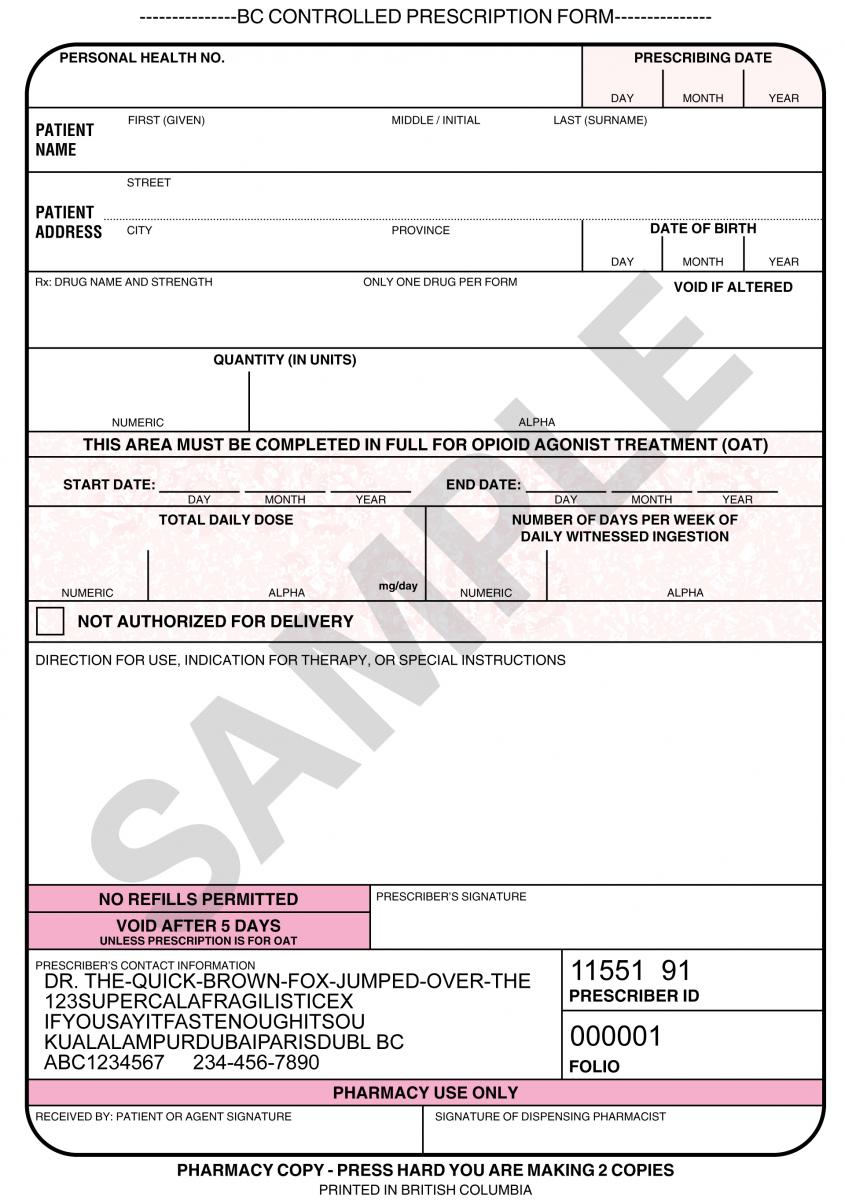
A controlled substance prescription is a written order from a
licensed healthcare provider for medications that have a potential for
abuse or dependence. These medications are categorized into different
schedules based on their potential for abuse, accepted medical use, and
the likelihood of causing dependence. Here’s a more detailed breakdown
of your questions:
- Advantages of a Controlled Substance Prescription:
- Helps regulate the distribution and use of medications with abuse potential.
- Enables healthcare providers to closely monitor patients who require these medications for legitimate medical reasons.
- Allows for tracking and reporting of controlled substance prescriptions to prevent misuse and diversion.
- Uses of a Controlled Substance Prescription:
- Pain management: Many controlled substances, such as opioid analgesics, are prescribed to relieve moderate to severe pain.
- Treatment of certain medical conditions: Controlled substances may
be prescribed to manage conditions like anxiety disorders, attention
deficit hyperactivity disorder (ADHD), and insomnia. - Anesthesia: Some controlled substances are used in medical procedures for sedation or anesthesia.
- Types of Controlled Substance Prescriptions:
- Controlled substances are categorized into different schedules
(Schedule I through V) based on their potential for abuse and medical
use. - Schedule I substances have a high potential for abuse and no
accepted medical use, while Schedule V substances have the lowest
potential for abuse and accepted medical use. - Examples of controlled substances include opioids (e.g., oxycodone,
morphine), stimulants (e.g., Adderall, Ritalin), benzodiazepines (e.g.,
Xanax, Valium), and certain sleep medications (e.g., Ambien, Lunesta).
- Controlled substances are categorized into different schedules
- How to Get a Controlled Substance Prescription:
- Schedule an appointment with a licensed healthcare provider, such as a doctor or nurse practitioner.
- Discuss your medical condition and symptoms with the provider.
- If the provider determines that a controlled substance is necessary
for your treatment, they will evaluate your medical history, conduct any
necessary examinations or tests, and then issue a prescription if
appropriate. - Controlled substance prescriptions are subject to stricter
regulations, including limits on the duration of validity, number of
refills, and requirements for electronic prescribing in some
jurisdictions.
- Who Can Issue a Controlled Substance Prescription:
- Only licensed healthcare providers who are authorized to prescribe controlled substances can issue these prescriptions.
- This typically includes physicians (MDs and DOs), nurse
practitioners (NPs), physician assistants (PAs), and, in some cases,
dentists and other specialized healthcare providers.
- Where Can a Controlled Substance Prescription be Used and for How Long:
- Controlled substance prescriptions can be used at pharmacies to obtain the prescribed medication.
- The duration of validity and number of refills allowed for a
controlled substance prescription depend on the medication’s schedule
and local regulations. - Typically, prescriptions for Schedule II controlled substances
(e.g., most opioids) have stricter regulations and may not allow for
refills, while prescriptions for Schedule III-V controlled substances
may allow for a limited number of refills within a specified timeframe.







Reviews
There are no reviews yet.